
Therapeutic Education
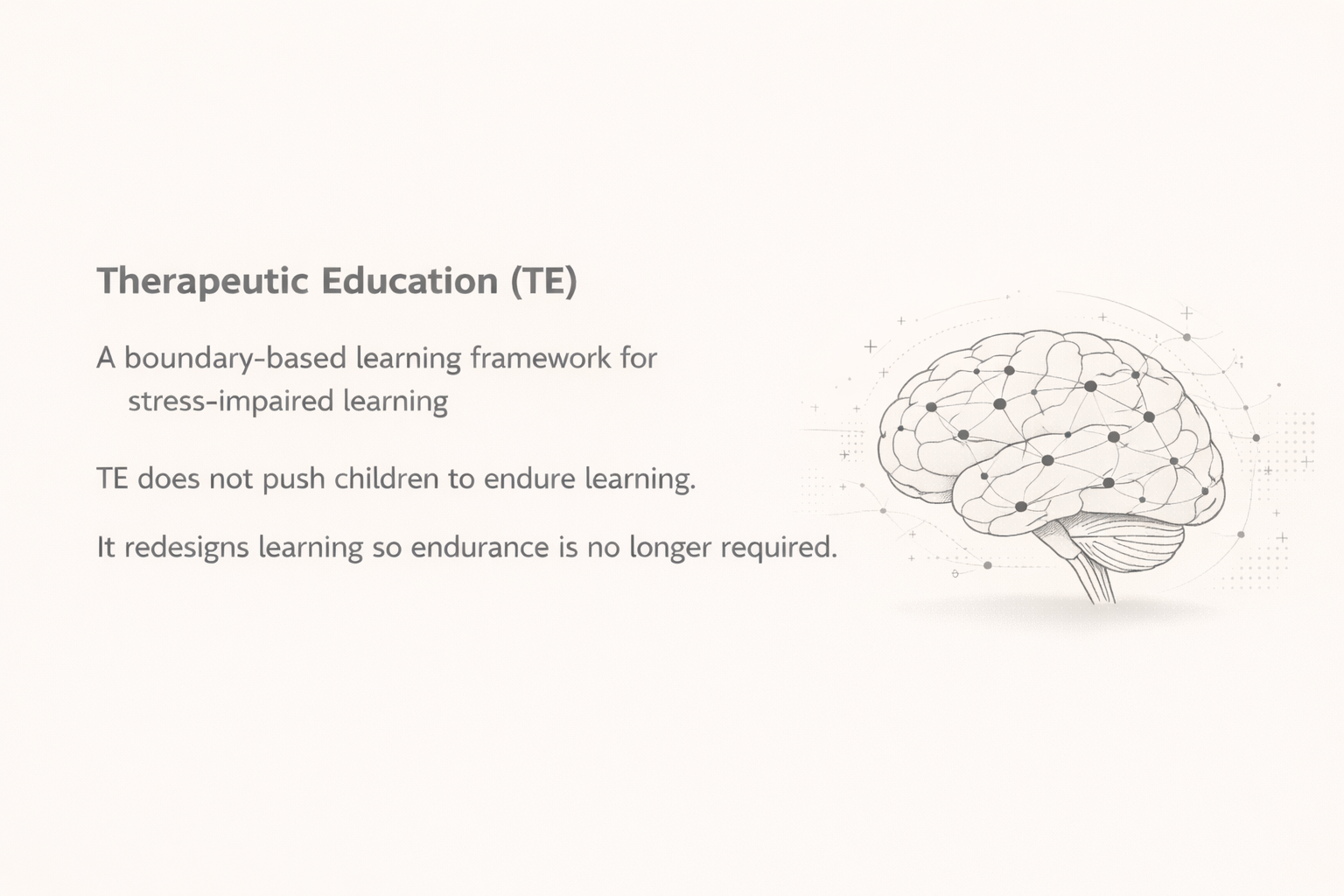
An emerging framework for studying the conditions under which learning remains possible under stress, overload, or fluctuating capacity.
Education must not demand what a nervous system cannot give.
Many learners remain physically present in education while learning has become neurologically inaccessible to them.
Enterability
the momentary possibility of initiating engagement with a learning task.
Entry Cost
the cognitive and regulatory effort required to begin the next learning action.
Capacity
the learner’s learning energy available at a given moment to engage with a task.
Continuity
the persistence of enterable engagement across successive moments of interaction.
Observation
When learning does not become possible
Some learners do not fail because they refuse to learn. They fail because educational engagement never becomes stable enough to continue.
This example illustrates a contrast that many educators, parents, and clinicians recognize immediately. In one context, the child remains physically present but learning does not consolidate into steady engagement. In another, attention stabilizes and the child becomes absorbed.
The contrast is often misread as a difference in motivation. Therapeutic Education proposes a different interpretation. What changes is not only desire, but the structure of engagement itself.
In some learning situations, the next moment does not become easy to inhabit. Entry remains fragile. Orientation must be rebuilt. Effort does not accumulate. The learner appears to be “there,” while repeatedly falling out of the learning process.
The problem may emerge before understanding is ever tested.
By contrast, in experiences that sustain engagement, the learner does not have to repeatedly re-establish contact with the activity. The interaction holds together across time. Attention stabilizes. Effort becomes sustainable.
Learning requires not only entry, but continuity of entry across successive moments.
Therapeutic Education studies this boundary: the conditions under which learning remains possible, and the conditions under which it quietly becomes inaccessible.
Read more in the Canonical Statement , The Discovery , or The Laws .
Therapeutic Education
Learning does not begin when instruction is given. It begins when entry becomes possible.
The problem
Many learners today do not fail because they lack ability.
They fail because learning becomes impossible to begin.
Assignments that should take minutes stretch into hours. Capable students sit in front of work they understand — yet cannot start. Effort turns into avoidance. Confidence collapses.
What appears as laziness or loss of motivation often hides something else.
Learning has become inaccessible.
A missing concept
Educational systems traditionally evaluate learning through performance, knowledge, effort, and motivation.
But another condition exists before all of these.
The possibility of entry.
A task may be understandable yet impossible to begin.
When this happens, learning cannot occur.
Therapeutic Education calls this condition enterability.
A structural boundary
Learning does not fail only when understanding fails.
It fails when the structure of learning demands more than the learner's nervous system can provide.
Stress, overload, anxiety, neurodivergence, and instability reduce the capacity required to engage with learning.
When educational demand repeatedly exceeds that capacity, tasks become non-enterable.
Avoidance emerges.
Learning identity erodes.
The learner remains enrolled — but is quietly leaving learning itself.
A different question
Traditional education asks:
How do we make learners try harder?
Therapeutic Education asks a different question:
Was the task enterable?
If a task cannot be entered, it cannot teach.
The second condition
Beginning is not enough.
Learning unfolds as a sequence of moments across time.
If each next moment requires rebuilding entry from the beginning, engagement fragments and effort becomes unsustainable.
Learning therefore depends on continuity — the persistence of enterable interaction across successive moments.
A simple law
Therapeutic Education proposes a structural principle:
"Learning persists only while successive moments remain enterable."
— The Law of Continuous Enterability
When this condition holds, effort becomes sustainable and learning accumulates.
When it fails, avoidance replaces engagement regardless of motivation or ability.
The paradigm
Therapeutic Education studies the conditions under which learning remains possible.
It does not redefine what must be learned.
It examines how learning is asked of the learner.
The paradigm begins with a boundary:
"Education must not demand
what a nervous system cannot give."
— The founding principle of Therapeutic Education
Within this boundary, learning may begin.
Within continuity, learning may endure.
An emerging field
Therapeutic Education is an emerging scientific framework.
It invites educators, researchers, and institutions to examine learning not only as the transmission of knowledge, but as a dynamic interaction between educational structures and human nervous systems.
Learning must remain possible.
Common Questions About Therapeutic Education
Many people recognize the problem immediately but need clarity about what Therapeutic Education is — and what it is not.