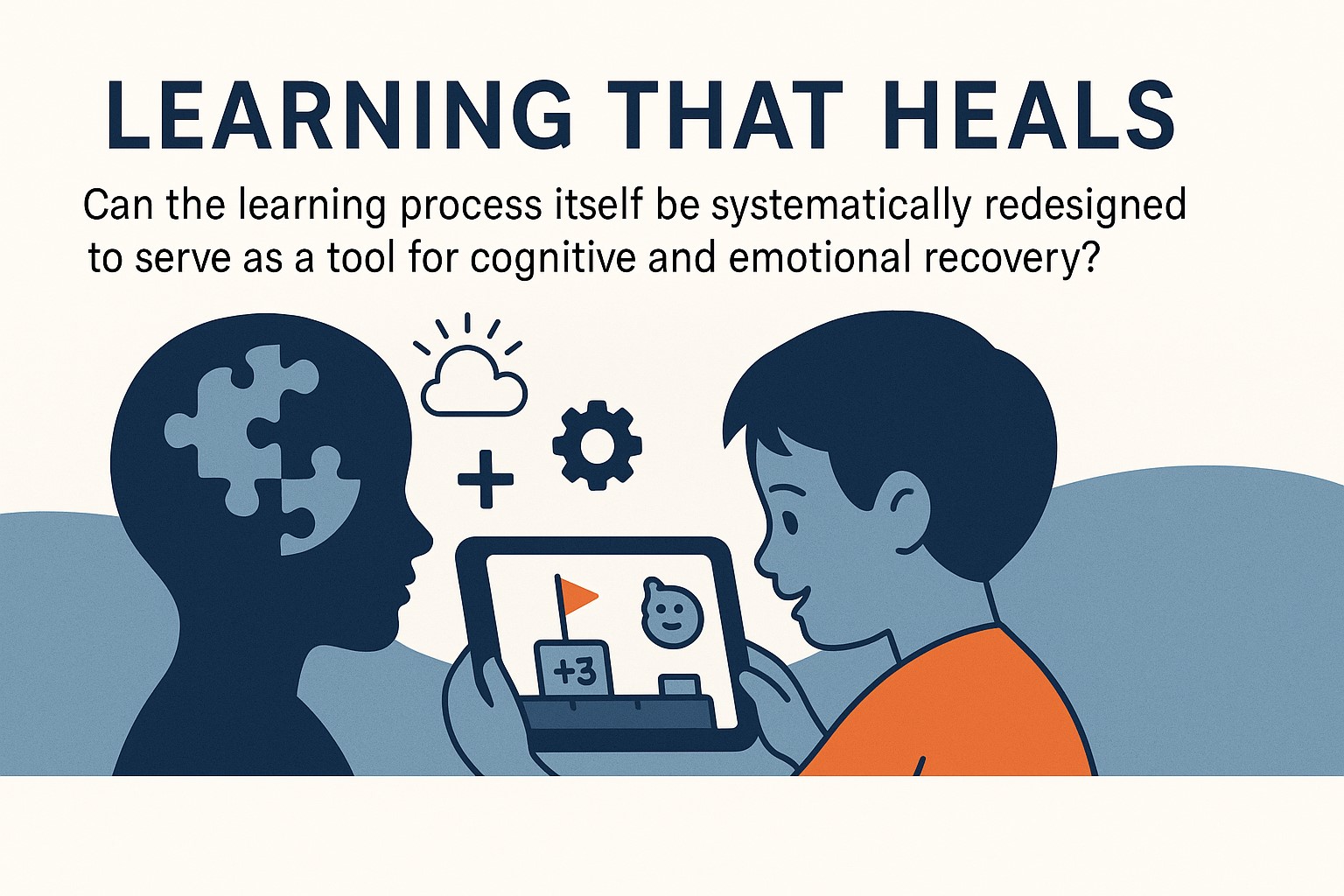
When learning itself becomes the intervention
Learning That Heals is not a therapy, a treatment, or a promise of recovery.
It is a recognition of something education has long ignored:
learning experiences are not neutral.
Under certain conditions, learning can deepen stress, avoidance, and cognitive shutdown. Under different conditions, learning can stabilize, regulate, and gradually restore access to thinking.
Therapeutic Education exists to define those conditions.
The problem Learning That Heals addresses
Many children today do not stop learning because they lack ability or motivation.
They stop because learning has become neurologically inaccessible.
Under sustained stress — war, displacement, anxiety, neurodivergence, chronic pressure — the nervous system prioritizes survival. Functions required for learning (attention, working memory, error tolerance, planning) are down-regulated.
When this happens, standard educational demands are experienced as threat.
Homework becomes unbearable.
Mistakes feel dangerous.
Starting feels impossible.
At that point, learning does not merely fail — it harms.
What "healing" means here (and what it does not)
Learning That Heals does not mean:
- clinical treatment
- trauma therapy
- emotional processing
- motivational coaching
- "making learning fun"
Therapeutic Education does not claim to heal trauma.
Instead, it asserts a more limited — and more urgent — responsibility:
Education must stop reproducing harm when learning is no longer possible.
"Healing" in this context means:
- removing structurally injurious conditions
- reducing unnecessary threat signals
- restoring a sense of cognitive safety
- making learning enterable again
Not curing — stabilizing.
Not pushing — allowing access.
Learning as a stabilizing process
When learning is redesigned within appropriate constraints, it can function as a regulatory environment rather than a stressor.
This happens when learning activities are:
- predictable rather than surprising
- reversible rather than punitive
- non-competitive rather than comparative
- short, bounded, and stoppable
- free from public judgment or time pressure
Under such conditions, the nervous system can down-regulate defensive responses.
Only then do cognitive capacities begin to re-engage.
In this sense, learning itself can become therapeutic by design — not because it treats trauma, but because it ceases to reproduce it.
A shift in responsibility
Traditional education assumes that when learning fails, the learner must adapt.
Therapeutic Education makes a different ethical claim:
When learning becomes inaccessible,
the first variable to adapt is not the learner —
but the learning environment.
Learning That Heals is the practical expression of this shift.
It does not lower standards.
It does not remove learning.
It does not excuse disengagement.
It redesigns how learning is asked of the learner — so that learning can happen at all.
Why this matters now
A growing population of learners is being silently displaced from education.
Not by lack of content.
Not by lack of intelligence.
But by formats that exceed their current capacity.
When education ignores this, it becomes a source of secondary harm:
- learned helplessness
- chronic avoidance
- identity damage ("I can't learn")
Learning That Heals exists to interrupt this trajectory.
From paradigm to method to implementation
Learning That Heals is not a standalone technique.
It is the conceptual core of Therapeutic Education.
From this core:
- methods can be developed that respect nervous-system constraints
- technologies can encode safety, reversibility, and accessibility
- learning formats can be transformed without changing content
One such implementation is PlayTellect — but the paradigm is larger than any single product.
A boundary, not a promise
Learning That Heals does not promise success, speed, or recovery.
It sets a boundary:
Education must not demand what a nervous system cannot give.
Within that boundary, learning may resume.
Beyond it, learning collapses.
Therapeutic Education exists to formalize this boundary — and to ensure learning remains possible for those who have been pushed out of it.
In summary
Learning That Heals means:
- learning is not neutral
- learning can injure or stabilize
- design choices matter neurologically
- access precedes performance
- safety precedes efficiency
This page defines why Therapeutic Education exists.
The Canonical Statement defines what it is.
The Method defines how it operates.
Implementations demonstrate that it can be done.